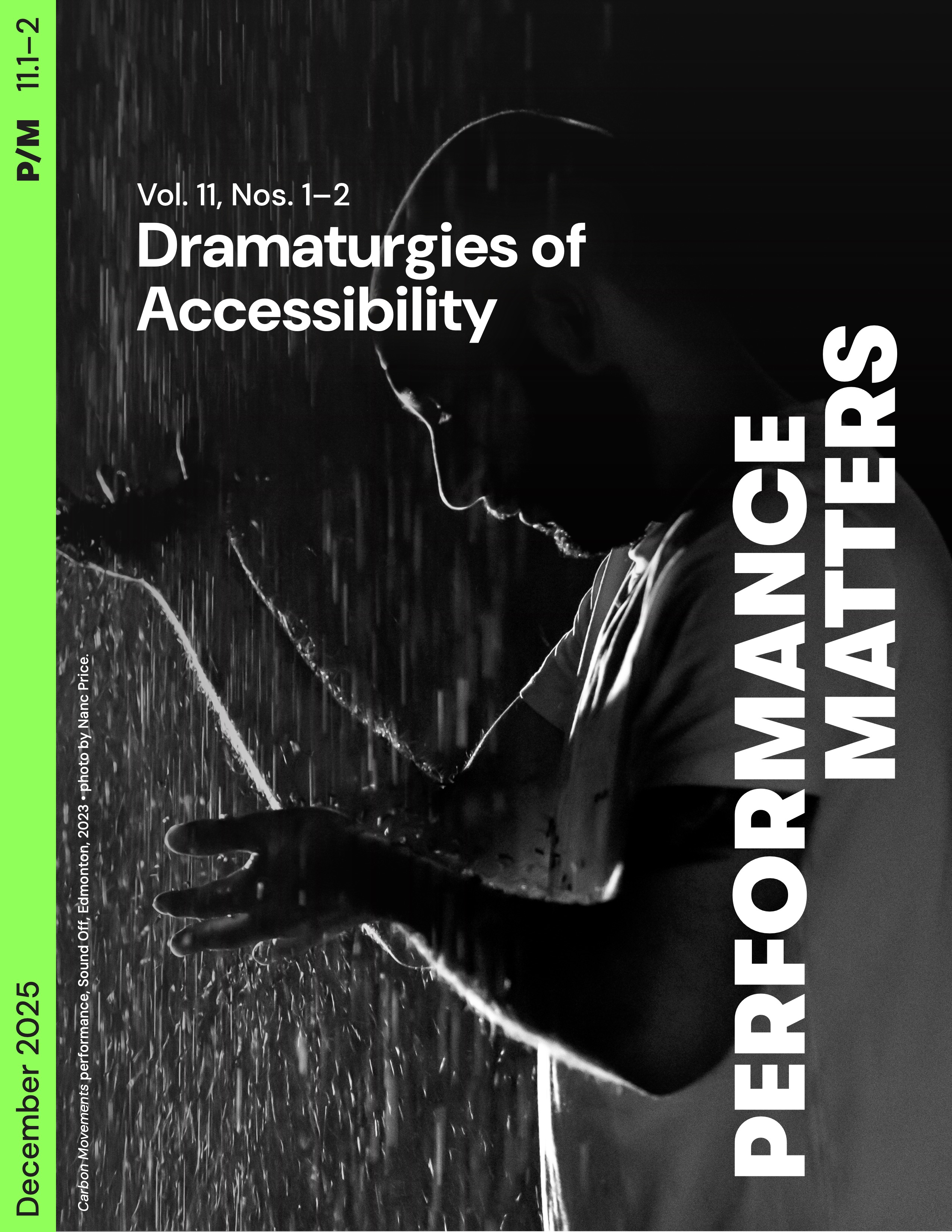
Dramaturgies of Accessibility
Abstract
In this editorial, we position the journal issue between developments in expanded dramaturgy, access dramaturgy, and conceptions of disability. This is first done through an introduction to the basics of dramaturgy and accessibility. Dramaturgy enhances attention to how artists and audiences experience. In turn, this attention can be applied to consider whose strengths are placed at the centre of creation from the outset. When the strengths of people with disability and different ways of experiencing are embedded in creation methods and compositional principles with care, then sensory registers are expanded and disabling norms give way to accessibility. Authors in this issue advance such forms of embedded accessibility in their creative, educational, and research practices. Looking at what dramaturgies of accessibility become through these authors’ examples, we map the following topics: (1) awareness of how disability troubles normative ways of working; (2) working and learning with the people in in the room; (3) expanding ways of imagining, communicating, and sensing; (4) working with the aesthetics, ethos, and rigorous practices of accessibility; and (5) weaving and Re-stor(y)ing to produce accessible realities. Paying it forward, we invite readers/listeners to draw inspiration and partake in a growing community of knowledge on dramaturgies of accessibility.
Downloads
Published
How to Cite
Issue
Section
License
Copyright (c) 2025 Pil Hansen, Jessica Watkin

This work is licensed under a Creative Commons Attribution-NonCommercial-NoDerivatives 4.0 International License.
Copyright for articles published in this journal is retained by the authors, with first publication rights granted to the journal. By virtue of their appearance in this open access journal, articles are free to use, with proper attribution, in educational and other non-commercial settings.
Manuscripts submitted to Performance Matters should be original works that have not been published elsewhere. Note that authors are responsible for obtaining permission to include copyrighted material in any article or review published in Performance Matters.