Editorial Notes
Abstract
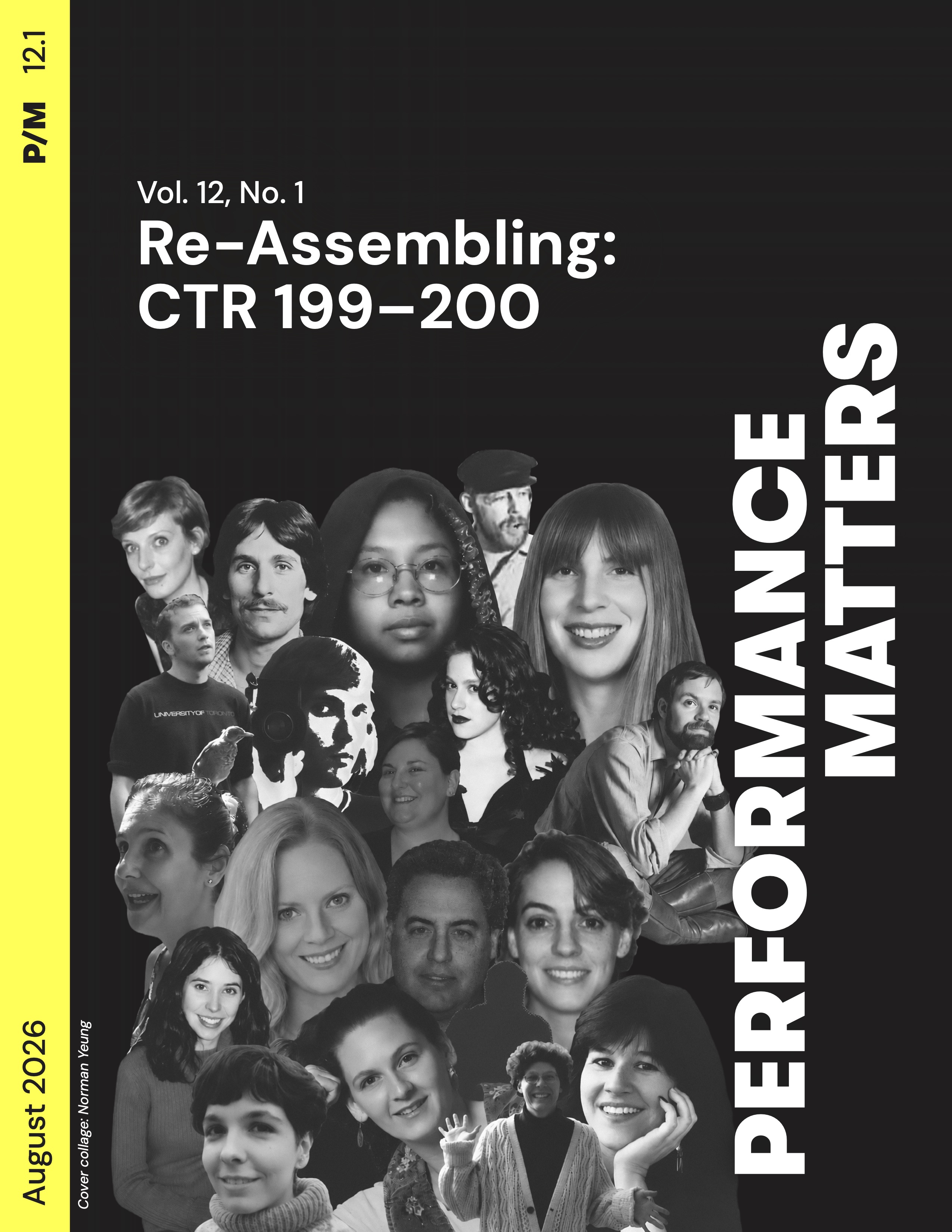
Readers encountering the title and content of this special issue, “Reassembling: CTR 199-200,” might be a bit befuddled. Why, you might ask, is Performance Matters journal publishing an issue of Canadian Theatre Research? As our esteemed guest editors Selena Couture and Melissa Poll detail in their editorial introduction to this special issue, the reasons are connected to a larger crisis around academic freedom and editorial futures in Canadian theatre and performance publishing. The ten articles that appear in this special issue of Performance Matters were originally published in 2024 as part of a 50th anniversary issue of Canadian Theatre Review. Issue 199-200 of CTR, “Core Samples and Cross Sections: CTR at 50,” was edited by Heather Davis-Fisch (editor-in-chief at the time), Jenn Stephenson (CTR editor-in-chief, 2016–2023), and dance artist and scholar Seika Boye. After publication and against the editors’ wishes, the publisher decided to remove one of the articles from the issue after a complainant took issue with its intersectional feminist analysis and threatened legal action. As Couture and Poll explain in their editorial introduction to this issue: “In response to this censorship and in support of the scholar whose work had been removed from the publication, nineteen authors rescinded their permission for the press to publish their articles in the issue. CTR 199-200 was disassembled and republished without what the editors termed the ‘omitted’ articles in September 2025. The articles were listed at the end of the editorial introduction without comment on the circumstances of their removal.”
We are honored that Couture and Poll approached Performance Matters as a potential home within which to reassemble the censored and rescinded articles and we are delighted that readers will now be able to read them on our open access online platform or use our print-on-demand feature. All of the articles retain the original editing as part of our commitment to honoring the editorial work of Davis-Fisch, Stephenson, and Boye. Each article is now accompanied by a response by an artist or scholar, which acts as an open peer review. In their introduction, our guest editors approach “assembly” as a practice of gathering together—both as a collective act of political solidarity and as an editorial process of curation, collaboration, and support. This issue is an assembly in the broadest sense: every editor, author, article, and response is gathered together around a shared commitment to integrity and imagination in the shifting landscapes of scholarly research and publishing.
In the CTR editor roundtable in this issue, Laura Levin and Ric Knowles discuss the concept of “shadow editing” as a commitment to creating “the conditions that let you shine in what you’re doing.” Rather than taking the lead, the editor is in a support role: “I will be there in the wings—not as a named lead on the issue, but as backup—to offer support if anything tricky comes up.” In this formulation, editing is more than just fostering the conditions for authors and artists to create and share the work that matters most to them. Editing is also about bringing practices of care, ethics, and attention to asking: what perspectives and practices are given to matter in our publishing infrastructures? Performance Matters is grateful for the opportunity to provide a platform for this assembly and we look forward to exploring how we can engage in assembling more accountable and supportive publishing futures.
Downloads
Published
How to Cite
Issue
Section
License

This work is licensed under a Creative Commons Attribution-NonCommercial-NoDerivatives 4.0 International License.
Copyright for articles published in this journal is retained by the authors, with first publication rights granted to the journal. By virtue of their appearance in this open access journal, articles are free to use, with proper attribution, in educational and other non-commercial settings.
Manuscripts submitted to Performance Matters should be original works that have not been published elsewhere. Note that authors are responsible for obtaining permission to include copyrighted material in any article or review published in Performance Matters.